Experience the heart of Berlin with our comprehensive guided walking tour covering over 15 historical landmarks and monuments.
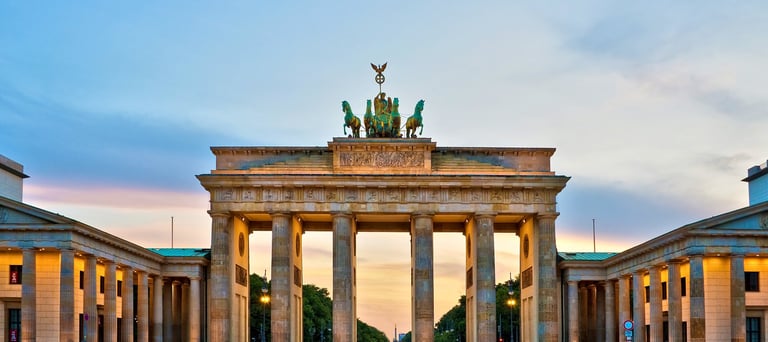
The perfect place to begin your tour, the Brandenburg Gate is the most famous and most recognizable monument in Berlin. It is a splendid 18th c. Neo-Classical monument that has featured prominently in the political history of Prussia, France, the Soviet Union, and both divided and unified Germany.
Historically, the grandest square in Berlin and the sight of many important historical events. It's home to the U.S. and French Embassies, and the famous Hotel Adlon.
Hitler had a multi-story underground structure built that served as his final residence, along with many Nazi officials, and as his place of death. It was deliberately destroyed after WWII and now a parking lot occupies the site.
A vast plaza of irregular blocks, set at varying heights, inducing a maze-like sense of disorientation to abstractly convey the horrors of the Holocaust.
A 19th c. Neoclassical column, 67 m (219 ft) in height, that is one of the most recognizable monuments in Berlin.
Note: We get a nice view of the column from near the Brandenburg Gate but DO NOT walk to the column as it is somewhat far and out of the direction of the itinerary.
Seat of the former legislature of the German Empire, Weimar Republic and later a symbol for the Nazi regime. In ruins for decades, it was reconstructed, combining classical and modern elements, and now is the seat of the federal Parliament.
Berlin's main river has a beautiful boardwalk passing some of the city's best new architecture. It is an experience no visitor should miss.
Historically, Friedrichstraße was both a symbol and literal dividing and crossing point for East and West Berliners. It was a place of transit, control and sometimes trauma.
Palace of Tears: Known as the Tränenpalast, it was a departure hall for West Berliners who made trips to visit friends and family in the East. They then had to say goodbye, on the other side, as they returned home.
A UNESCO World Heritage Site and home to some of the world's most important museums. It's very picturesque and your walk will pass by these magnificent buildings:
Charming Baroque revival style building, home to sculptures, Byzantine art, medals, and coins.
Home to the Pergamon altar, Ishtar Gate, and the Market Gate of Miletus.
Home to a famed Egyptian collection which includes the bust of Nefertiti.
Berlin's first museum, designed by Karl Schinkel, home to classical antiquities.
Monumental German neo-Renaissance building which is the largest Protestant church in Germany. It also houses the dynastic tombs of the Hohenzollern family.
Beautiful 18th century square, home to the Pantheon-inspired St. Hedwig's Catholic Cathedral (St.-Hedwigs-Kathedrale) and the State Opera House (Staatsoper Berlin).
Prussian liberal arts University which is now an esteemed public university. Karl Marx, Engels, and Einstein taught here, along with 28 other Nobel Laureates.
The site of a major Nazi book burning in 1933, tens of thousands of works were lost. See the innovative memorial commemorating the loss.
"Where they burn books, they will, in the end, burn people."
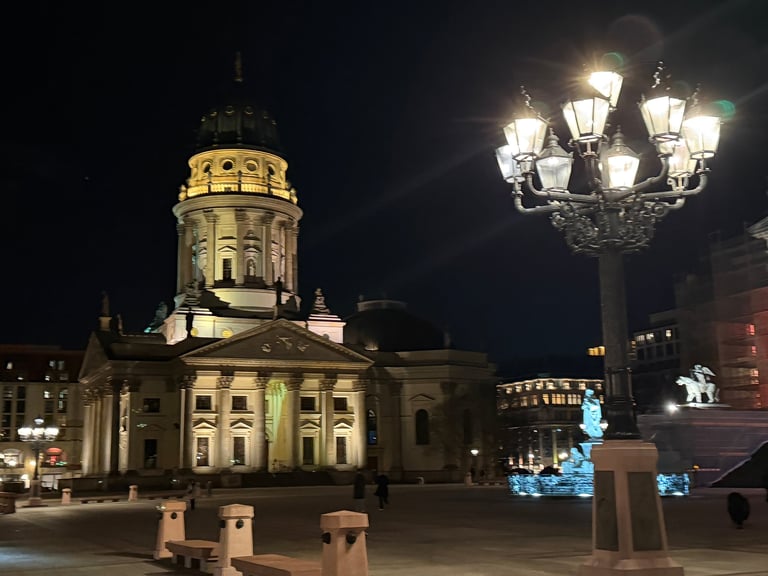
Impressive square that is known for its architecture ensemble featuring:
The best known Berlin Wall crossing point from East Berlin to West Berlin. Located in the American quarter, it served as a face-off between the USA and the western world and the USSR and the communist world. It was the site of John F. Kennedy's famous Berlin speech and has been featured in countless movies and novels.
Memorial created in 1998 that preserves a 60 m (200 ft) long section of "the Wall," the way it was when it fell.
Visitor Center: Open Tuesday-Sunday from 10 am - 6 pm (closed Mondays, December 24th, December 25th, and January 1st). Features information about the wall, including a short video, remnants of the wall as well as historic photos.
Outdoor and indoor history museum which sits on the site of former Nazi buildings including the Gestapo. The exhibitions chronicle the rise of the Nazi party, their means of control through propaganda and various forms of terror, as well as their fall and accountability at the trials at Nuremberg.
Hours: Open 10 am - 8 pm daily (closed December 24th, December 25th and January 1st)
The tour ends here so, if you desire, you can stay and visit the Berlin Wall Memorial exhibitions and/or the Topography of Terror museum on your own. Both are free of charge.
Just opposite the entrance to the Topography of Terror at Niederkirchnerstraße 8.
Kochstraße on the U6 line (8 min walk) or Potsdamer Platz on the U2 line.
Anhalter Bahnhof serves the S1, S2, S25, and S26 lines.